

There is a particular moment couples dread. You send the invitation, you feel a small wave of relief, and then a message comes back from your grandmother, or your partner's uncle, or the whole French side of the family: we opened it, but we cannot read it. What was meant to make everyone feel invited has quietly done the opposite. Half your guests are left guessing at the date, squinting at a button they cannot understand, unsure whether they were even asked.
If your families do not all read the same language, this is the problem that matters most, and it is the one most invitation tools handle worst. We build one of these tools, so read this for what it is: an honest comparison, not a neutral one. We have tried to be fair about what the other tools do well, and just as honest about where Laylaty is not the right fit. Where we mention a competitor's limitation, it is what real couples have said in public reviews and planning forums, framed as their experience, not a claim of our own. Tools change often, so check each one's current site before you decide.
Key takeaways
Key takeaways
If your guest list is bilingual or multicultural, the tool has to do more than translate a few words. It needs to show each guest the invitation, the card, and the RSVP form in their own language, and it needs to lay out Arabic correctly, right to left. Most of the popular free builders are English-first. Some let you paste a translation underneath a section, but couples report that the date, the location, and the RSVP button often stay stuck in one language. Laylaty runs in 9 languages including native, right-to-left Arabic, and each guest can open the invitation in their own language from a personal link. Pricing is per event, not a monthly plan.
Why "multilingual" is not a nice-to-have
For a lot of couples, a bilingual wedding is not a preference, it is simply the family they come from. One partner grew up speaking Arabic at home, the other grew up in English. The grandparents who traveled the furthest are often the ones least comfortable reading a foreign language on a small screen. These are exactly the people you most want to feel included, and they are the first ones a single-language invitation leaves out.
The workarounds couples invent are telling. A screenshot of the details, translated by hand in a notes app. A second website in the other language, sent separately, that slowly drifts out of sync with the first. A French link buried in a group chat that nobody is sure is the current one. None of it is anyone's fault. It is what happens when the tool was only ever built for one language and you are trying to be kind to a family that speaks two.

What to look for in a multilingual invitation tool
Before the comparison, here is what actually separates a tool built for more than one language from one that merely tolerates a second. Four things are worth checking.
True per-guest language, not one page for everyone. The goal is that each guest opens the invitation already in the language they read, without hunting for a switcher or being handed the wrong link. On Laylaty, that happens through a personal link, a link unique to each guest that opens their invitation in their language and keeps the RSVP count clean. It is different from a single shareable link that sends everyone to the same English page.
Real right-to-left support for Arabic. This is the one most tools get wrong. RTL stands for right to left, the reading direction of Arabic. It is not a font swap. A proper right-to-left page mirrors the whole layout: the text aligns to the right, the reading order flows from the right edge of the screen to the left, and the buttons move with it. A page that is translated into Arabic but still laid out left to right reads backwards to a native reader, which is exactly the broken result couples run into with tools that treat Arabic as an afterthought.
A card, not just a caption. Some tools let you translate the words on a website but stop at the invitation card itself, the designed piece your guest actually sees first. Worth checking whether the card, the date on it, and the names render properly in each language, including a non-Latin script like Arabic.
The RSVP in their language too. It is not enough for the invitation to be readable if the reply form is still in English. Localization means adapting the whole experience to the visitor's language, not just the headline: the questions, the buttons, the confirmation they see after they reply. That is the part that decides whether a guest can actually respond without asking you for help.
At a glance: how the multilingual tools compare
| Tool | Languages | Arabic, right to left | Each guest's own language | Pricing model |
|---|---|---|---|---|
| Laylaty | 9, including native Arabic | Yes, native RTL across the card, site, and RSVP | Yes, per guest via a personal link | Free up to 40 guests, then from €19 per event |
| WedSites | Multiple, via translation | Not documented here, confirm with them | Couples report it sends the right language to the right guest | Paid plans, described by couples as on the pricier side |
| Joy (WithJoy) | English-first, some fields translatable | Not built for it | No automatic per-guest default reported | Free, funded by registry and upgrades |
| The Knot | English-first | Not a built-in feature | Not a built-in feature | Free, funded by registry and vendors |
| Zola | English-first | Not a built-in feature | Not a built-in feature | Free, funded by registry and upgrades |
| Do it yourself | Any, by hand | Only if you build it | You send separate links per language | Free, but the work is all yours |
A quick, fair note on the free ones. When The Knot, Zola, and Joy are free, that is not a mystery, it is registry commissions, vendor referrals, and paid upgrades. That is worth knowing going in, not a reason to avoid them. And everything in this table shifts over time, so treat it as a starting point and confirm the current details on each tool's own site.
The honest rundown, tool by tool
Laylaty
Laylaty is built around the idea that a couple's guest list is rarely one language. The guest-facing side, the invitation, the designed card, and the RSVP form, can each run in any of 9 languages: English, Arabic, German, Spanish, Finnish, French, Japanese, Swedish, and Chinese. Arabic is laid out properly right to left, not mirrored text bolted onto an English layout, and the card renders in Arabic script with the date shown in Arabic-Indic numerals rather than left in Latin digits.
The mechanism that makes it feel effortless for guests is the personal link. Each guest gets a link that opens their invitation in their own language, so your Arabic-speaking aunt reads the whole thing in Arabic and your French friends read it in French, all from the one event you set up once.
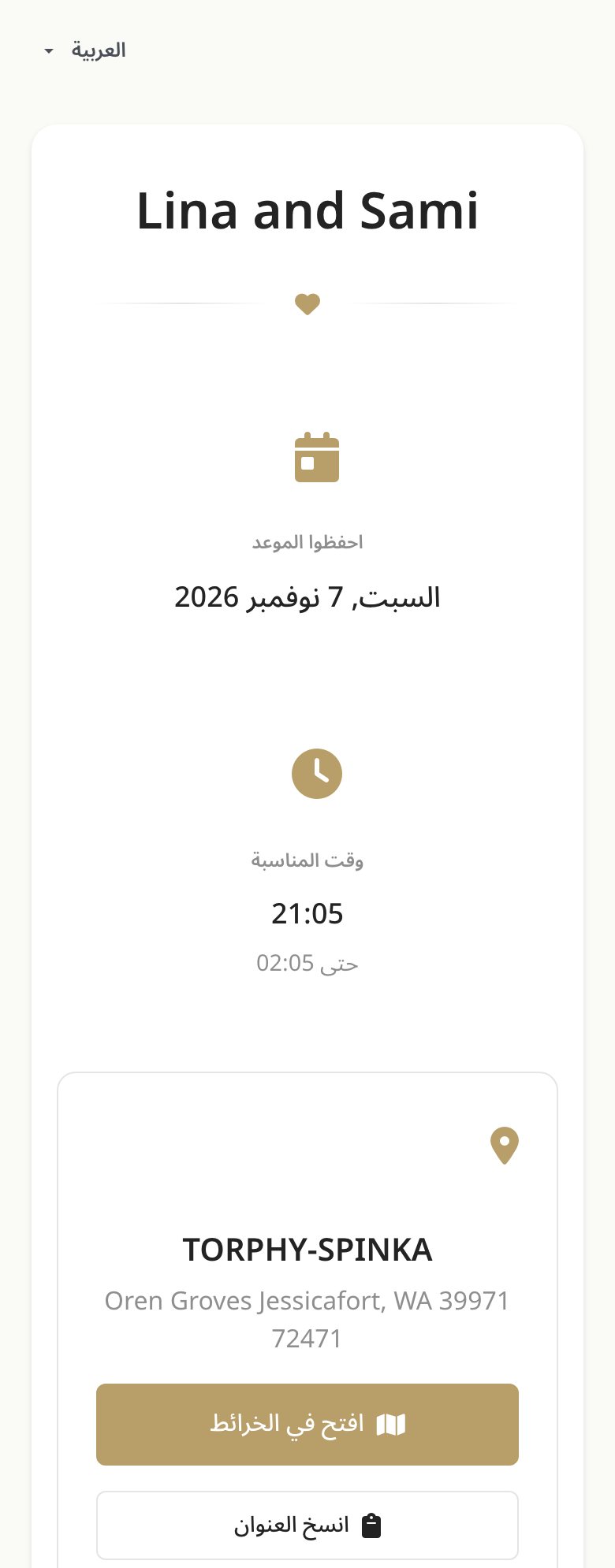
Pricing is per event, not a monthly subscription, starting free for up to 40 guests and moving to paid plans from €19 as the guest list and features grow, with VAT added at checkout. Best for a couple whose families do not all read the same language and who want that handled properly rather than patched around.
WedSites
WedSites comes up again and again when couples in planning forums go looking for genuine bilingual support, and the reports are positive. One couple described it as pricey but well worth it, specifically because it translated their content and sent each guest the correct language. If your budget has room and you want a website-led tool with translation built in, it is a real option worth pricing out. We cannot speak to how it handles Arabic right-to-left layout specifically, so if Arabic is your must-have, confirm that directly with them before you commit. Best for a couple who wants a translation-capable website and does not mind paying a premium for it.
Joy (WithJoy)
Joy's free website is popular for a reason, with a large library of templates and a polished feel. On the multilingual side, though, couples describe hitting a wall. One noted that even when you manually translate each section underneath the English, certain things cannot be edited at all, giving the date, the location, and the RSVP buttons as examples that stayed in one language. Another mentioned that names in the title could only be shown in one script or the other, not both, which is a real problem for a couple whose names are written in different alphabets. Best for a couple whose guests all read English and who wants a strong template library.
The Knot and Zola
The Knot and Zola are the two big US builders, both free, both centered on a gift registry with a wedding website attached. For a US-based couple registering for gifts and inviting an English-speaking guest list, that bundle is genuinely convenient. Multiple languages, and Arabic in particular, are not what they are built for, so if your guest list crosses languages, you would be working against the grain. Best for an English-speaking couple who wants their website and registry in one place.
Doing it yourself
It is worth naming the most common option honestly, because so many couples end up here by default: building the workaround yourself. A second site in the other language, a translated image of the details, separate links for separate sides of the family. It is free and it is fully under your control. It is also fragile. Every time a detail changes, you have to change it in every language yourself, and it is easy for one version to fall out of date without anyone noticing until a guest shows up an hour early. Best only if your second-language list is very small and you enjoy the upkeep.
Where Laylaty isn't the answer
Be honest with yourself about this first
The wedding website and public guest registration are paid features, included from the Essential plan (from €19 per event) upward. The free plan covers invitations, RSVPs, and a guest list for up to 40 guests, not a public multilingual website. Storage for guest photos and videos is finite on every plan, never "unlimited."
Fill in the languages your guest list actually needs
Turning a language on makes it available, but it does not write your content for you. Two or three languages, each filled in with care by you or a fluent relative, read far better than five languages half-finished. A native speaker will catch a tone that no auto-translator can.
Frequently asked questions
Can I really send my invitation in Arabic, with the layout going the right way?
On Laylaty, yes. Arabic is a full right-to-left layout, so the whole page mirrors rather than just the words being swapped, and the card and RSVP form follow suit. Among the tools here, it is the one built for this from the start. The others are English-first, and couples who have tried to work around that describe manual translation, duplicate sites, or fields that simply cannot be edited.
Does each guest see the invitation in their own language automatically?
On Laylaty, each guest opens their invitation through a personal link that shows it in their language, so you are not asking your relatives to find and use a switcher. Couples report that WedSites also sends the correct language to the correct guest. On the free English-first builders, there is no built-in per-guest default that we are aware of.
What does a free wedding tool actually cost me?
Usually not money, but attention. The Knot, Zola, and Joy are free because they earn from gift registry commissions, vendor referrals, and paid upgrades. That is a fair trade for many couples, it is just worth knowing. Laylaty charges per event instead, free for up to 40 guests and priced per event beyond that, rather than earning from a registry.
My oldest relatives are not online at all. What about them?
No digital tool solves this on its own, and it is fair to plan around it. The pattern most couples land on is a hybrid: send the digital invitation to everyone who is online, in their language, and print a small card with a QR code for the few who are not. That way nobody is left out, and you still get most of your replies tracked in one place.
Do my guests have to download an app?
No. On all of these tools, guests open a link in a browser and reply there. There is nothing to install, which matters even more when a guest is already navigating an unfamiliar language.
Ready to send an invitation everyone can actually read?
Create your event free for up to 40 guests, turn on the languages your family and friends actually read, and see the invitation in each one before you send a single link.